

Punch List vs. Final Clean: What General Contractors Actually Need at the Finish Line
On most builds, framing is not where the schedule falls apart. The end is. The gap between the last trade rolling off and the client walkthrough is short, it is crowded, and it is where a project either finishes on the date you promised or quietly slides past it.
A lot of that gap comes down to one step that gets treated as an afterthought: the clean. So it is worth being clear about what a post-construction clean actually is, and what it is not.
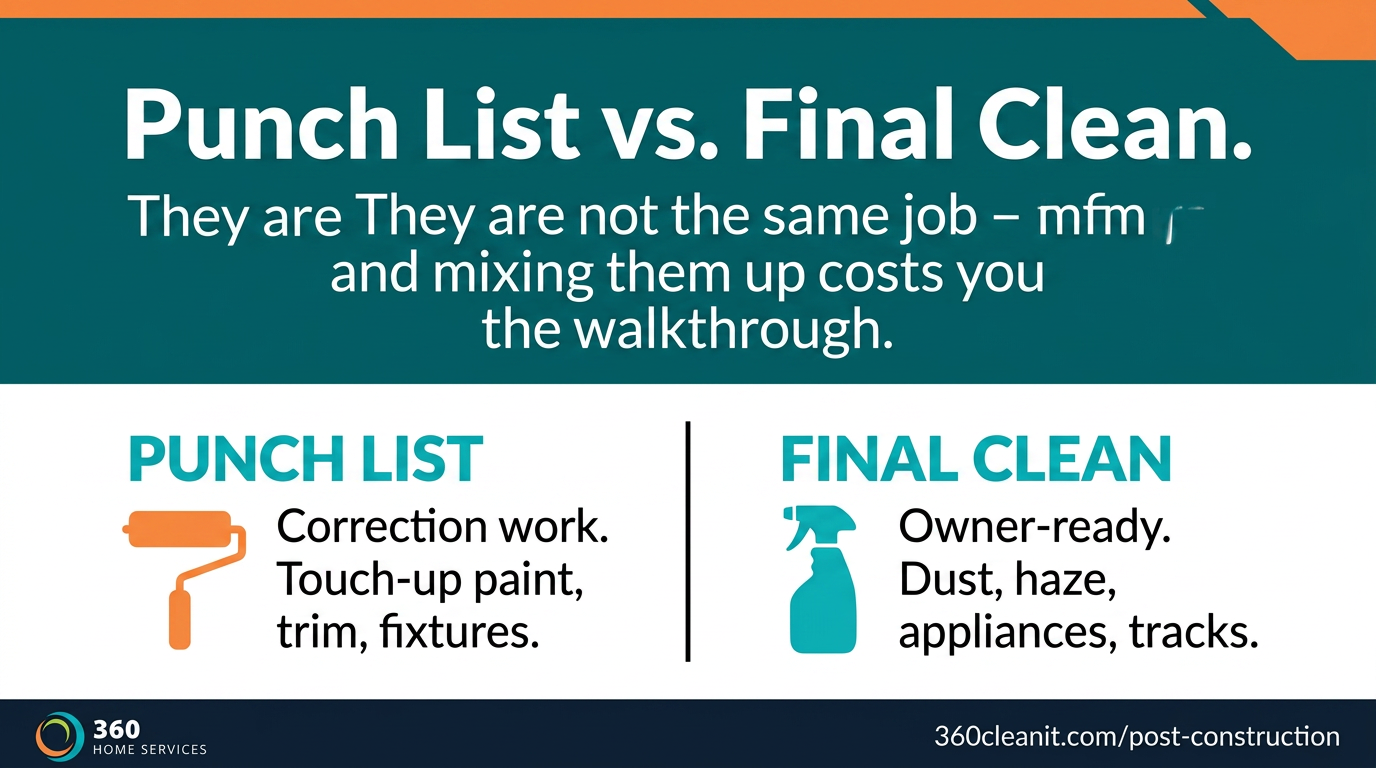
A punch list and a final clean are not the same job
A punch list is the running record of items that still need correction before closeout: the touch-up paint, the trim that needs another nail, the fixture that is not seated right. It is correction work, and it belongs to your trades.
A final clean is the pass that makes the finished space ready for an owner to walk and an inspector to sign. It is the construction dust pulled off the tops of door frames and out of the window tracks, the adhesive and grout haze taken off new glass and tile without scratching it, the stickers off the appliances, the marks off every switch plate and handle.
The two get blurred because they happen in the same window, at the end, under the same time pressure. But when a “clean” is really just a broom-out and a trash haul, the punch list reopens. The owner walks in, runs a finger across the top of a cabinet, finds drywall dust, and now you are explaining yourself instead of handing over keys.
What a GC is actually buying
A general contractor does not buy cleaning. You buy a finish line you can put on the calendar.
You buy a space the client can walk the first time without leaving with a new list. You buy the certificate-of-occupancy date staying where you set it. You buy your reputation with that owner, who will decide whether to call you for the next project based partly on how the last one ended.
That reframes what reliability is worth. A clean that slips a day is not a small inconvenience. It pushes the walkthrough, which pushes closeout, which erases the schedule every trade protected by finishing early. The clean sits at the pinch point, so its reliability either holds the whole end of the project together or lets it come apart.
The dust you cannot see is the dust that comes back
Fine construction dust does not stay where a quick wipe leaves it. Drywall dust in particular is light enough to resettle for days after a build, which is why a surface that looked clean on Tuesday can look dusty again on Thursday. The U.S. Environmental Protection Agency notes that fine particulate matter stays airborne and settles slowly, and that construction and renovation generate a great deal of it. The Occupational Safety and Health Administration treats silica-bearing construction dust as a recognized hazard for exactly that reason.
The practical takeaway for a builder is simple: post-construction dust has to be removed in a way that accounts for resettling, working top down, capturing it rather than just pushing it around, and covering the vents and returns where it hides. A single surface wipe is how it comes back twice.
Rough clean, final clean, and why timing matters
The cleanest builds we work on plan for the cleaning partner more than once.
A rough clean happens mid-project, after the dusty trades and before finishes go in. It clears debris and heavy dust so the next trades are working in a clean space and the new finishes are not fighting grit from the day they are installed.
A final clean happens after the last trade rolls off and before the walkthrough. This is the detail pass that makes the space owner-ready.
When both are planned into the schedule instead of squeezed in at the end, three things happen. The trades before us work in a better space. The finishes you already paid for stay protected. And the walkthrough is not the first time anyone has looked closely at the result. The clean stops being a last-minute scramble and becomes a step you can build a calendar around.
A crew you manage versus a partner you do not
Here is the difference that matters most when you are running every trade on a job at once.
A crew waits to be told the scope, shows up when it suits them, and leaves you to discover what they missed at the worst possible moment. A partner reads the punch list, plans the clean around your closeout, and tells you the truth about timing before it costs you a day.
You should not have to manage the clean the way you manage a new sub. It should be the one step that simply happens, on the date committed, to the same standard every time. That is the bar we hold ourselves to on every build, and it is why we ask for the punch list and the schedule up front instead of showing up with a mop and guessing.
What to ask a post-construction cleaning partner before the next build
A few questions tell you quickly whether you are hiring a crew or a partner:
Do they price by square footage and scope, so the number is predictable? Will they walk the punch list and the schedule with you before the date? Do they distinguish a rough clean from a final clean, or treat it all as one broom-out? And will they tell you honestly when the space is not actually ready for them yet, instead of cleaning early and charging you to come back?
The answers tell you whether your finish line is in good hands.
If you are a general contractor or builder in Greater Phoenix and you want the clean to be the one step you never have to chase, take a look at how we handle post-construction work at https://360cleanit.com/post-construction/, or request a quote at https://360cleanit.com/contact-get-a-quote. We would be glad to be the partner who protects your finish line.
Sources: U.S. Environmental Protection Agency, indoor particulate matter and construction dust guidance (epa.gov); Occupational Safety and Health Administration, construction silica dust standard (osha.gov).


0 Comments